
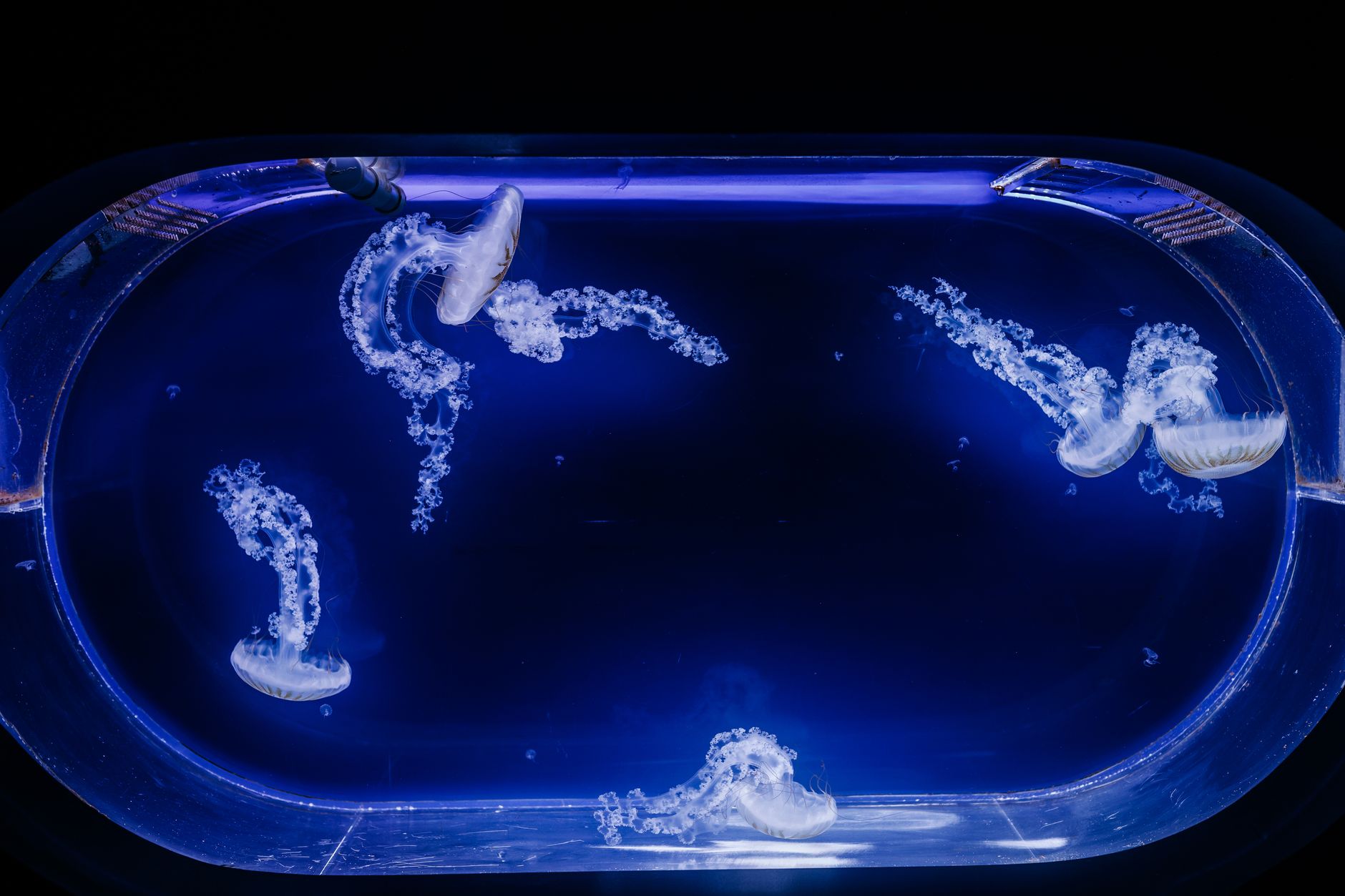
What Supports Jellyfish? The Secrets of Their Buoyancy and Survival
Jellyfish are supported by a combination of factors, primarily water’s buoyancy and the jellyfish’s unique composition, which includes a high water content and specialized internal structures that aid in maintaining their position in the water column.

Introduction: The Enigmatic Jellyfish
Jellyfish, those ethereal and often mesmerizing creatures, glide through our oceans, captivating scientists and beachgoers alike. But have you ever stopped to consider what supports jellyfish? Unlike fish with their skeletons and swim bladders, jellyfish appear almost impossibly fragile. Their existence hinges on a delicate interplay of physics, biology, and environmental factors. Let’s delve into the fascinating world of jellyfish to understand the mechanisms that allow these gelatinous organisms to thrive.

What colours are fish most attracted to?
Can you put your finger in a trout's mouth?
Is methylene blue anti bacterial?
Does aquarium salt raise pH in aquarium?
Jellyfish Composition and Buoyancy

The key to understanding what supports jellyfish lies in their composition. Jellyfish are composed of approximately 95-98% water. This high water content makes them nearly neutrally buoyant, meaning they weigh almost the same as the surrounding water. This dramatically reduces the amount of energy they need to expend to stay afloat.
- High water content leads to near-neutral buoyancy.
- Minimal energy expenditure for maintaining position.
The Role of the Mesoglea
The mesoglea is a gelatinous, non-cellular substance that makes up the bulk of a jellyfish. It acts as a hydrostatic skeleton, providing structural support and flexibility. Think of it like the jelly in a jelly doughnut – it gives the jellyfish its form and allows it to maintain its shape as it moves through the water. The mesoglea is critical to what supports jellyfish.
Contraction and Propulsion
Jellyfish move by contracting their bell-shaped bodies, expelling water and propelling themselves forward. This method of propulsion, though seemingly simple, is surprisingly efficient. The contractions are coordinated by a nerve net, a decentralized nervous system that allows the jellyfish to respond to its environment. This movement also helps in regulating their position in the water column.
Water Currents and Vertical Migration
While jellyfish can move on their own, they are also influenced by water currents. They often drift with the currents, allowing them to cover vast distances with minimal energy expenditure. Some jellyfish also exhibit vertical migration, moving up and down in the water column in response to changing light levels, food availability, or temperature. This ability is crucial for what supports jellyfish in different parts of the ocean.
Environmental Factors
The environment plays a significant role in what supports jellyfish. Factors such as water temperature, salinity, and the availability of nutrients all affect jellyfish populations. Changes in these factors can lead to blooms, where jellyfish populations explode in number, or declines, where populations dwindle.
Avoiding Sinking: Density and Movement
Jellyfish often need to actively avoid sinking. Several mechanisms help them achieve this:
- Active Swimming: Regular contractions of the bell propel them upward, counteracting gravity.
- Ion Regulation: Some jellyfish regulate the ion content of their tissues, reducing their density and increasing buoyancy.
- Water Uptake: Adjusting water content in their bodies can impact their overall buoyancy.
Comparing Jellyfish Support to Fish Support
| Feature | Jellyfish | Fish |
|---|---|---|
| Skeletal System | Hydrostatic skeleton (Mesoglea) | Bony or cartilaginous skeleton |
| Buoyancy | Near-neutral buoyancy due to water content | Swim bladder (gas-filled organ) |
| Propulsion | Contractions of the bell | Fins and muscular body movements |
| Density Control | Ion regulation, water uptake | Swim bladder inflation and deflation |
| Reliance on Current | High reliance | Moderate reliance |
Frequently Asked Questions (FAQs)
Why are jellyfish mostly water?
Jellyfish are mostly water because it provides buoyancy and reduces the energy required for movement. Their bodies are optimized to blend seamlessly with their watery environment, making them efficient predators and minimizing the energy costs of staying afloat.
How do jellyfish move if they don’t have muscles like we do?
Jellyfish use specialized muscle cells in their bell that contract and relax to expel water, propelling them forward. While they don’t have muscles in the same way as vertebrates, these cells allow them to move efficiently through the water.
What happens to a jellyfish if it’s taken out of the water?
When a jellyfish is removed from water, it collapses due to gravity. Without the support of water, the mesoglea loses its shape, and the jellyfish essentially flattens out.
Can jellyfish control their buoyancy?
Yes, to a limited extent. Some jellyfish can regulate the ion content within their bodies to influence their density and, consequently, their buoyancy. This helps them maintain their position in the water column.
Do jellyfish have bones or a skeleton?
No, jellyfish do not have bones or a skeleton in the traditional sense. Instead, they rely on their mesoglea, a gelatinous substance that acts as a hydrostatic skeleton, providing support and flexibility.
How does salinity affect jellyfish?
Salinity influences the buoyancy and osmotic balance of jellyfish. Changes in salinity can stress jellyfish and even cause them to burst or shrink due to osmotic pressure imbalances.
Why are jellyfish sometimes found washed up on beaches?
Jellyfish often wash up on beaches due to a combination of factors, including strong currents, storms, and being caught in tides. They may also wash ashore after dying naturally or being injured.
What is the difference between a jellyfish and a man-of-war?
A jellyfish is a single organism, while a man-of-war is a colony of individual organisms working together. While both are gelatinous and float in the ocean, their structure and organization are fundamentally different.
Do all jellyfish sting?
Not all jellyfish sting. While many jellyfish possess nematocysts (stinging cells), some species have weak or non-existent stinging capabilities. However, it’s always best to exercise caution around jellyfish.
How do jellyfish find food if they are drifting?
Jellyfish are opportunistic feeders. They use their tentacles to capture prey that drifts within their reach. Their tentacles are covered in nematocysts, which inject venom to paralyze or kill their prey.
What eats jellyfish?
Many animals prey on jellyfish, including sea turtles, some fish species, and even other jellyfish. Jellyfish are an important part of the marine food web.
How do jellyfish reproduce?
Jellyfish have a complex life cycle that involves both sexual and asexual reproduction. They can reproduce by releasing eggs and sperm into the water, or by budding off new individuals from a polyp stage attached to the seabed. The polyp stage helps what supports jellyfish population stability over time.