
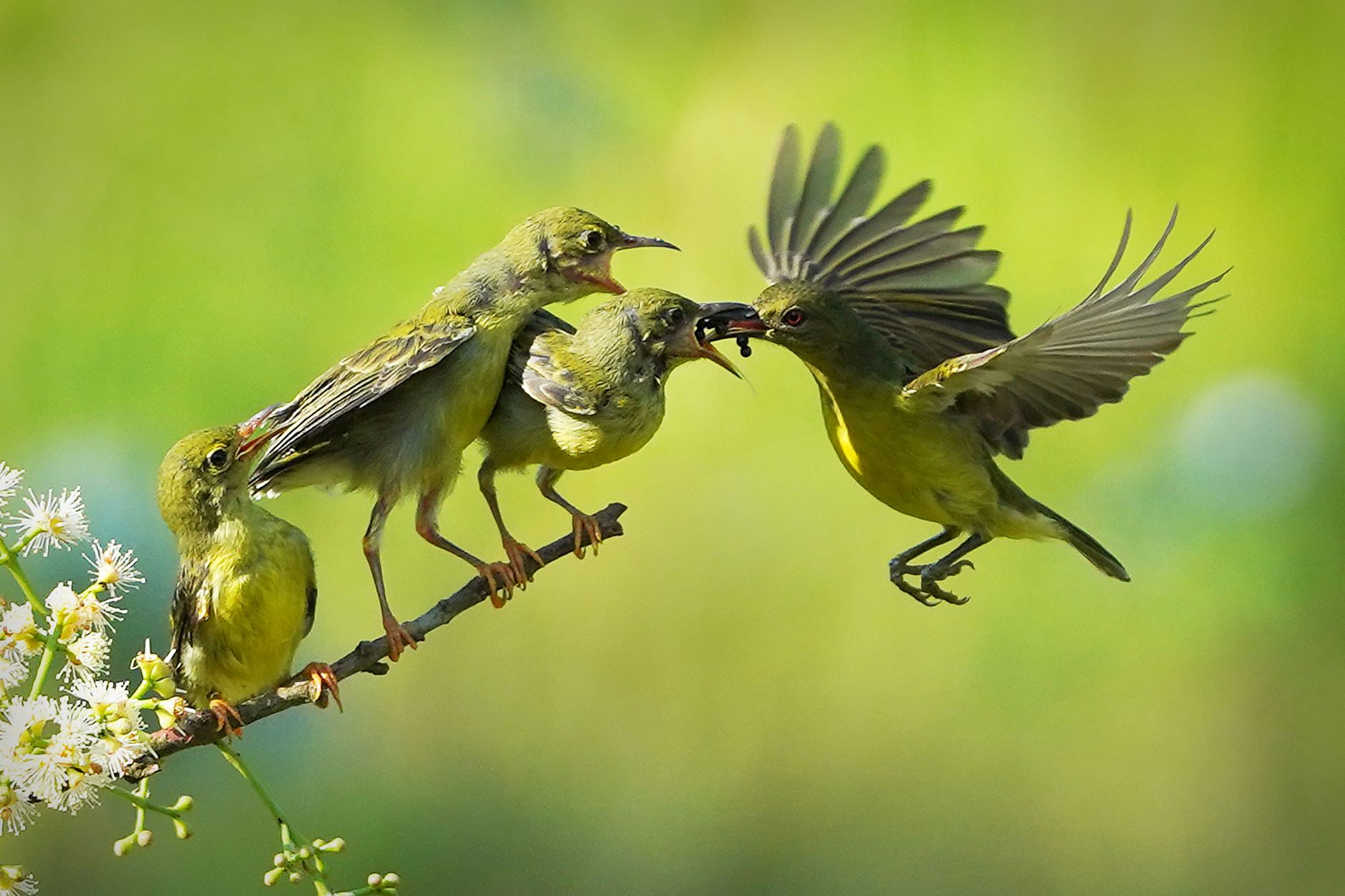
Do Birds Remember Their Parents? A Deep Dive into Avian Memory
Do birds remember their parents? The answer is complex, but research indicates that many bird species possess the capacity for limited parental recognition, especially within the context of their initial fledging period, but lasting recognition in adulthood is far less common and species-dependent.

The Intricate World of Avian Memory and Parental Bonds
Understanding the extent to which birds remember their parents requires delving into the fascinating world of avian cognition, development, and social behavior. Unlike mammals, where maternal care often extends well beyond infancy and relies heavily on scent and physical touch, the bird-parent relationship is frequently shorter and primarily focused on providing food and protection until the young can fend for themselves. This difference in parental investment shapes the type and duration of memories formed.

What colours are fish most attracted to?
Can you put your finger in a trout's mouth?
Is methylene blue anti bacterial?
Does aquarium salt raise pH in aquarium?
Early Imprinting and Recognition Mechanisms

The initial bond between a bird and its parents is largely driven by imprinting, a critical period of learning early in life where young birds learn to identify and follow their primary caregiver. This imprinting is usually visual and auditory, with chicks quickly learning the appearance and calls of their parents.
- Visual Cues: Chicks may learn to recognize specific plumage patterns or facial features (if applicable).
- Auditory Cues: Recognizing parental calls is crucial for begging for food and staying safe.
- Spatial Memory: Chicks often learn the location of the nest and surrounding area relative to their parents.
These early imprints create a foundation for subsequent recognition. However, the longevity of these memories varies significantly.
Species-Specific Variations in Parental Recognition
The extent to which birds remember their parents is highly species-dependent.
| Species Group | Typical Parental Care Duration | Likelihood of Long-Term Recognition | Explanation |
|---|---|---|---|
| Precocial Birds | Short | Low | Chicks are relatively independent at hatching; parental recognition is less critical. |
| Altricial Birds | Longer | Higher (initially) | Chicks require extensive parental care, leading to stronger initial bonds. |
| Socially Complex Birds | Extended Family Groups | Moderate to High | Species that live in family groups (e.g., scrub jays) may maintain recognition of relatives, including parents, for extended periods. |
Precocial birds, like ducks and chickens, are relatively independent at hatching and can often find food and move around on their own soon after birth. Therefore, while they initially imprint on their parents, the need for ongoing recognition diminishes rapidly. Altricial birds, such as songbirds, require extensive parental care and develop stronger initial bonds, but even these bonds often fade after the young birds become independent. Socially complex birds, living in extended family groups, have a higher likelihood of maintaining recognition of relatives, including parents, for extended periods. This is often due to the benefits of cooperative breeding and defense.
The Role of Cognitive Abilities
The capacity for long-term parental recognition is also influenced by a bird’s cognitive abilities. Birds with larger relative brain sizes and more complex social structures are generally better equipped to remember individuals. These abilities enable them to discriminate between different individuals, even after prolonged periods of separation.
Challenges in Studying Avian Memory
Studying avian memory presents significant challenges. Determining whether a bird truly “remembers” its parents or simply reacts to familiar cues is difficult. Controlled experiments, often involving visual or auditory stimuli, are used to assess recognition, but replicating natural conditions in a laboratory setting is complex. Furthermore, ethical considerations limit the extent to which researchers can manipulate family structures.
Ethical Considerations
Research on bird behavior always incorporates stringent ethical guidelines to minimize disturbance to their natural environments and ensure the well-being of the study subjects.
Frequently Asked Questions (FAQs)
Can birds distinguish their parents from other birds of the same species?
Yes, especially during the early stages of life. Visual and auditory imprinting allows young birds to differentiate their parents’ specific appearance and calls from those of other adults, forming a crucial part of the early parent-offspring bond.
At what age do young birds typically stop recognizing their parents?
It depends on the species, but in many songbird species, recognition often fades within weeks of fledging, once the young birds become independent and disperse. Parental recognition beyond the first few months is less common.
Do migratory birds remember their parents after migrating?
Generally, no. The separation caused by migration typically leads to a breakdown of parental recognition. The enormous distances and extended periods of separation make sustained recognition unlikely.
Do birds remember their siblings?
Similar to parental recognition, sibling recognition is often limited to the initial fledging period, particularly in non-social species. However, in species that form long-term family groups, sibling recognition may persist.
How do scientists test if birds recognize their parents?
Researchers often use playback experiments, where they present birds with the calls of their parents and unrelated adults, and then observe their responses. Visual recognition can be tested by showing birds images of their parents.
Does raising birds in captivity affect their ability to recognize their parents?
Yes, raising birds in captivity can disrupt the natural imprinting process and potentially impair their ability to recognize their parents. Controlled environments may not provide the necessary cues for proper development of recognition skills.
What role does genetics play in a bird’s ability to recognize its parents?
Genetics likely plays a role in shaping the brain structures and cognitive abilities that underlie parental recognition. Inherited traits influence the capacity for learning and memory.
Are there any specific bird species that are known for remembering their parents for an extended period?
Some corvid species, such as scrub jays, are known for their complex social structures and may exhibit recognition of family members, including parents, for longer periods. These birds live in extended family groups and engage in cooperative breeding.
Does a bird’s personality influence its ability to recognize its parents?
Possibly. Birds with greater social intelligence or a stronger inclination to form social bonds may be more likely to retain memories of their parents. However, this is an area that requires further research.
Can learned behavior influence a bird’s parental recognition abilities?
Yes. Early experiences and learning play a crucial role in shaping a bird’s ability to recognize its parents. The imprinting process is a form of learned behavior that is essential for recognition.
If a bird is separated from its parents and then reunited later, will it still recognize them?
The likelihood of recognition depends on the duration of separation and the bird’s age. If the separation occurs shortly after fledging, recognition may be possible. However, after extended periods, recognition is less likely, especially in non-social species.
What future research is needed to better understand avian parental recognition?
Future research should focus on using advanced neuroimaging techniques to examine the brain activity associated with parental recognition in birds. Investigating the genetic and environmental factors that influence memory formation is also crucial. Longitudinal studies tracking bird families over extended periods would provide valuable insights into the long-term dynamics of parental recognition.