
Tracking local weather patterns from your own backyard has never been easier or more precise. Whether you are a gardening enthusiast, a smart home hobbyist, or simply someone who wants to know exactly when to grab an umbrella, the right technology can provide invaluable insights into your immediate environment.
Finding the Best Smart Weather Station requires balancing sensor accuracy, connectivity options, and ease of maintenance. We have evaluated several leading models to help you understand which features matter most for your specific needs, ensuring you can make an informed decision for your home setup.
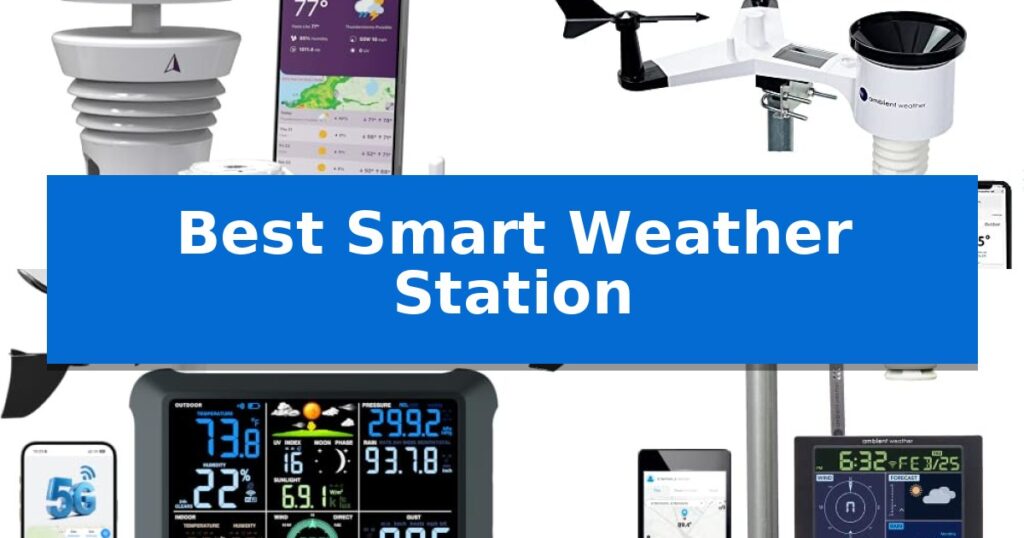
Best Smart Weather Station in 2026: Hyper-Local Data Access
1 WeatherFlow Tempest Weather Station — Maintenance-free sensor design
Reliable weather tracking requires precision and consistency, which is why the WeatherFlow Tempest Weather Station is engineered with an innovative, no-moving-parts design. By eliminating mechanical components that typically wear down over time, this system provides a maintenance-free solution for monitoring hyper-local atmospheric conditions directly from your property.
The Tempest Weather Station serves as an all-in-one monitoring hub, capable of tracking temperature, humidity, barometric pressure, wind speed and direction, dew point, solar radiation, UV index, lightning strikes, and rainfall. This comprehensive data collection is managed by a single, streamlined sensor unit that delivers real-time updates every 3 seconds, ensuring you have the most current information available.
Designed for seamless integration, the system features a solar-powered outdoor sensor that transmits data wirelessly up to 1,000+ feet. This robust connectivity allows for flexible placement in your backyard while maintaining a constant link to your home network. The station is built to withstand diverse environmental conditions, emphasizing long-term reliability and performance.
Beyond simple monitoring, the device excels in smart home automation. It integrates with platforms like Amazon Alexa, Rachio, and IFTTT, allowing users to trigger automated actions for irrigation systems, thermostats, or lighting based on live weather data. This connectivity transforms the station from a passive measurement tool into an active component of a modern, responsive home environment.
PROS
- No-moving-parts design ensures long-term durability and near-zero maintenance.
- Comprehensive all-in-one monitoring of ten different environmental metrics.
- Solar-powered sensor with a long-range wireless transmission of 1,000+ feet.
- Advanced smart home integration with Alexa, Rachio, and IFTTT for automated control.
CONS
- Wireless range may be subject to environmental interference depending on site layout.
2 Ambient Weather WS-2902 Weather Station — Best for smart home integration
Integrating hyper-local environmental data into your daily routine is simplified with the Ambient Weather WS-2902 Wi-Fi Smart Weather Station. This system features an Osprey Sensor Array that captures precise readings for wind speed, wind direction, temperature, humidity, rainfall, UV intensity, and solar radiation, all transmitted to a brilliant, easy-to-read LCD color display.
Beyond basic monitoring, this station is designed for smart home integration. It supports connectivity with IFTTT, Google Home, and Alexa, allowing users to program home automation based on real-time backyard weather conditions. The enhanced Wi-Fi capability ensures that data is transmitted wirelessly to the world's largest personal weather station network, providing a comprehensive view of local conditions.
The Ambient Weather WS-2902 includes a versatile Ambient Weather Network connection, which allows for the customization of dashboard tiles and the sharing of hyperlocal data via social feeds. This connectivity makes it a robust tool for those who want to track specific changes in their immediate environment with high accuracy.
With a compact footprint measuring 7.5 inches in length and 4.5 inches in height, the console fits easily into most home settings. The wireless sensor array is built to withstand outdoor elements, ensuring reliable data collection. Users benefit from a straightforward setup process that balances technical depth with accessible, real-time monitoring.
PROS
- Smart home ready with support for Alexa, Google Home, and IFTTT.
- Comprehensive Osprey Sensor Array measures seven distinct weather variables.
- Enhanced Wi-Fi connectivity for remote monitoring and network sharing.
- Includes a brilliant, easy-to-read LCD color display for immediate data access.
CONS
- Requires outdoor installation of the sensor array for accurate readings.
- Limited to one-year warranty coverage.
3 Sainlogic 5G WiFi Weather Station — Dual-band connectivity for stability
The Sainlogic 5G WiFi Weather Station offers a distinct advantage for large properties through its ultra-long transmission range of 135m / 443ft, which ensures stable data connectivity even when sensors are placed in remote areas of a farm or backyard. This capability eliminates common signal dropouts, making it a robust solution for users who require reliable environmental monitoring across expansive outdoor spaces.
Engineered for high performance, this smart WiFi weather station utilizes a high-precision imported Swiss chip to deliver industry-leading accuracy, specifically ±0.2°C for temperature and ±1.8% RH for humidity. The system integrates 5G/2.4G dual-band WiFi compatibility, allowing for 24/7 real-time updates and AI-powered weather forecasting. Users receive instant notifications via app or email whenever significant shifts in barometric pressure, temperature, or humidity occur, providing proactive awareness of changing conditions.
The hardware design centers on an 8.5-inch large LCD display that features wide-angle viewing, ensuring all metrics—including wind speed, rainfall, and moon phase—are legible from across a room. For precise installation, the included wireless rain gauge features a built-in bubble level, which helps prevent measurement errors. The system maintains high accuracy for rainfall, rated at ±1mm for rainfall under 15mm, and logs this data automatically into the inercom App.
Data management is streamlined through the 2-year historical data export feature. The station refreshes environmental data every 5 minutes, allowing users to visualize trends through intuitive charts or export records to Excel for detailed analysis. Supported by U.S.-based customer support, the unit is designed for long-term, hassle-free operation in various gardening, greenhouse, or home monitoring scenarios.
PROS
- Ultra-long 135m transmission range for remote sensor placement.
- High-precision Swiss-chip sensors for superior environmental accuracy.
- Dual-band 5G/2.4G WiFi connectivity for reliable real-time updates.
- 2-year historical data export capability for long-term trend analysis.
CONS
- Requires stable WiFi network for optimal AI forecast and alert functionality.
4 Ambient Weather WS-1965 Weather Station — Reliable all-in-one sensor array
Monitoring local weather patterns with precision requires reliable hardware that integrates seamlessly into a modern home. The Ambient Weather WS-1965 Wi-Fi Weather Station provides a comprehensive solution by combining an all-in-one sensor array with a vibrant color LCD display, ensuring that critical environmental data is always visible and accessible.
This system is engineered for accuracy, capturing essential metrics including temperature, humidity, barometric pressure, wind speed, wind direction, and rainfall. A standout feature is the 16-second real-time update interval, which pushes data directly to the console so you are never left waiting for the latest atmospheric changes.
Connectivity is a core strength of this model. Through enhanced Wi-Fi, the station transmits data wirelessly to the Ambient Weather Network (AWN). This integration allows users to customize dashboard tiles and share hyperlocal conditions across social feeds. Furthermore, the device is smart home ready, supporting integration with platforms like IFTT, Google Home, and Alexa to trigger automated home responses based on specific weather conditions.
Designed for straightforward installation, the Ambient Weather WS-1965 Wi-Fi Weather Station balances robust data collection with user-friendly digital management. While the system offers extensive remote monitoring capabilities, users should ensure their installation site has a clear, unobstructed path for the sensor array to maintain the integrity of wind and rainfall measurements.
PROS
- Includes an all-in-one sensor array for comprehensive environmental tracking.
- Features 16-second real-time data updates for immediate monitoring.
- Offers smart home compatibility with Alexa, Google Home, and IFTTT.
- Supports wireless data transmission to the Ambient Weather Network.
CONS
- Requires unobstructed placement to ensure accurate wind and rainfall readings.
5 Grillum Smart WiFi Weather Station — Includes five-day local forecasting
Planning for changing weather conditions becomes significantly more intuitive when you have a dedicated device that provides a comprehensive view of your local environment. The Grillum Smart WiFi Weather Station distinguishes itself by offering a 5-day weather forecast directly on its high-definition display, allowing users to track upcoming conditions with 23 built-in weather icons that simplify daily activity planning.
Beyond its forecasting capabilities, this station serves as a central hub for indoor and outdoor climate monitoring. It features a 4-level brightness HD screen that integrates temperature and humidity data alongside an alarm clock, ensuring the information remains legible regardless of ambient lighting. The device is designed for versatility, utilizing 3-channel support to monitor up to three distinct areas simultaneously with the included remote sensor.
Connectivity is a core strength of this system, as it utilizes smart WiFi sync to transmit real-time data directly to your smartphone. By integrating with the Tuya app, users can access historical trends, configure custom high/low temperature alerts, and toggle between Celsius and Fahrenheit settings remotely. This digital interface provides a streamlined way to manage environmental data from anywhere with a 2.4GHz connection.
The unit offers flexible power options to suit different placement needs. While it can run on batteries for basic data collection, plugging it into a power adapter unlocks the full suite of smart features and app connectivity. The adapter-powered mode also includes a convenient USB port, allowing the station to function as a charging hub for other mobile devices while it maintains your home weather tracking.
PROS
- 5-day weather forecasting with 23 distinct icons for easy planning.
- Smart WiFi connectivity allows for remote monitoring via the Tuya app.
- Integrated USB port provides added utility by charging other devices.
- 3-channel sensor support enables monitoring of multiple indoor or outdoor zones.
CONS
- WiFi and app features are disabled when the unit is running on battery power only.
- 2.4GHz WiFi compatibility is required for smart functionality.
Best Smart Weather Station Buying Guide
Sensor Array Reliability
The heart of any weather monitoring system is its sensor array. Look for units that offer all-in-one functionality, measuring critical metrics such as temperature, humidity, barometric pressure, and wind speed simultaneously. High-quality sensors should provide consistent, real-time updates to ensure your data remains relevant throughout the day.
Consider the physical design of the sensors as well. Models with no moving parts often require less maintenance over time, as they are less prone to mechanical wear from wind, rain, or debris. A solar-powered sensor array can also provide a significant advantage by reducing the frequency of battery changes.
Connectivity and Smart Integration
Modern weather stations thrive on their ability to communicate with your existing digital ecosystem. Ensure your chosen device supports WiFi connectivity, which allows for seamless data transmission to mobile apps or cloud-based platforms. This enables you to check your backyard conditions from anywhere, providing peace of mind when you are away from home.
For those building a connected home, look for compatibility with platforms like Amazon Alexa, IFTTT, or Google Home. These integrations allow you to automate other smart devices, such as adjusting your irrigation systems or thermostats based on the specific weather data collected by your station.
Transmission Range and Stability
If you have a large property or multiple buildings, the wireless transmission range is a critical specification. Some advanced stations offer an ultra-long transmission range, which helps prevent signal dropouts and connection issues. This is particularly important if your sensor array needs to be placed in a remote area of your garden or farm.
Additionally, check if the station supports dual-band WiFi (2.4GHz and 5GHz). This provides a more stable connection, ensuring that your data remains consistent even if your home network experiences interference. A reliable connection is essential for receiving instant alert notifications when environmental shifts occur.
Display and Data Visualization
While app-based monitoring is convenient, a high-quality LCD color display remains a staple for quick, at-a-glance information. Look for screens that offer wide-angle viewing and adjustable brightness levels, allowing you to read your data clearly from across the room regardless of the ambient lighting.
The ability to view historical trends is another valuable feature. Many smart stations allow you to export data or visualize it through intuitive charts on an app. This helps you track long-term environmental changes, which can be particularly useful for planning seasonal activities or managing greenhouse conditions.
Installation and Maintenance
Proper installation is key to accurate readings. Many stations include features like a built-in bubble level to ensure the rain gauge is perfectly horizontal, which minimizes measurement errors. Taking the time to mount your sensors correctly will pay off in the long run with more reliable data.
Maintenance requirements vary by model. Opting for a system with a maintenance-free design can save you significant time and effort. While some units may require occasional cleaning of the rain cup or sensor housing, choosing a robust, weather-resistant build will ensure your station performs well in various environmental conditions.
Frequently Asked Questions
Do I need a professional to install a smart weather station?
Most smart weather stations are designed for DIY installation. They typically come with mounting kits and clear instructions, though ensuring the sensor array is level and positioned away from heat sources is essential for accuracy.
Can I connect my weather station to my smart home irrigation system?
Yes, many smart weather stations integrate with platforms like IFTTT or specific brands like Rachio. This allows your irrigation system to automatically adjust watering schedules based on real-time rainfall data.
What is the benefit of a dual-band WiFi weather station?
A dual-band station supports both 2.4GHz and 5GHz frequencies, which provides a more stable and reliable connection to your home network, reducing the likelihood of data transmission drops.
How often should I clean the sensors?
Maintenance depends on your local environment. Generally, checking the rain gauge for debris and ensuring solar panels are clear of dust or leaves every few months is sufficient to maintain optimal performance.
Can I view my weather data if I am away from home?
Yes, as long as your weather station is connected to your home WiFi, you can access your real-time data and historical trends through the manufacturer's dedicated mobile app from anywhere with an internet connection.
Conclusion: Our Top Pick
Choosing the right equipment depends on your specific needs for connectivity, sensor precision, and maintenance. For those seeking a high-performance, low-maintenance solution that integrates seamlessly into a modern smart home, the WeatherFlow Tempest Weather Station stands out as a top recommendation.
With its innovative design that eliminates moving parts, this station offers exceptional reliability and long-term durability. Its ability to provide hyper-local weather data while integrating with major smart home platforms makes it an excellent choice for anyone looking to stay informed about their backyard environment with minimal effort.