
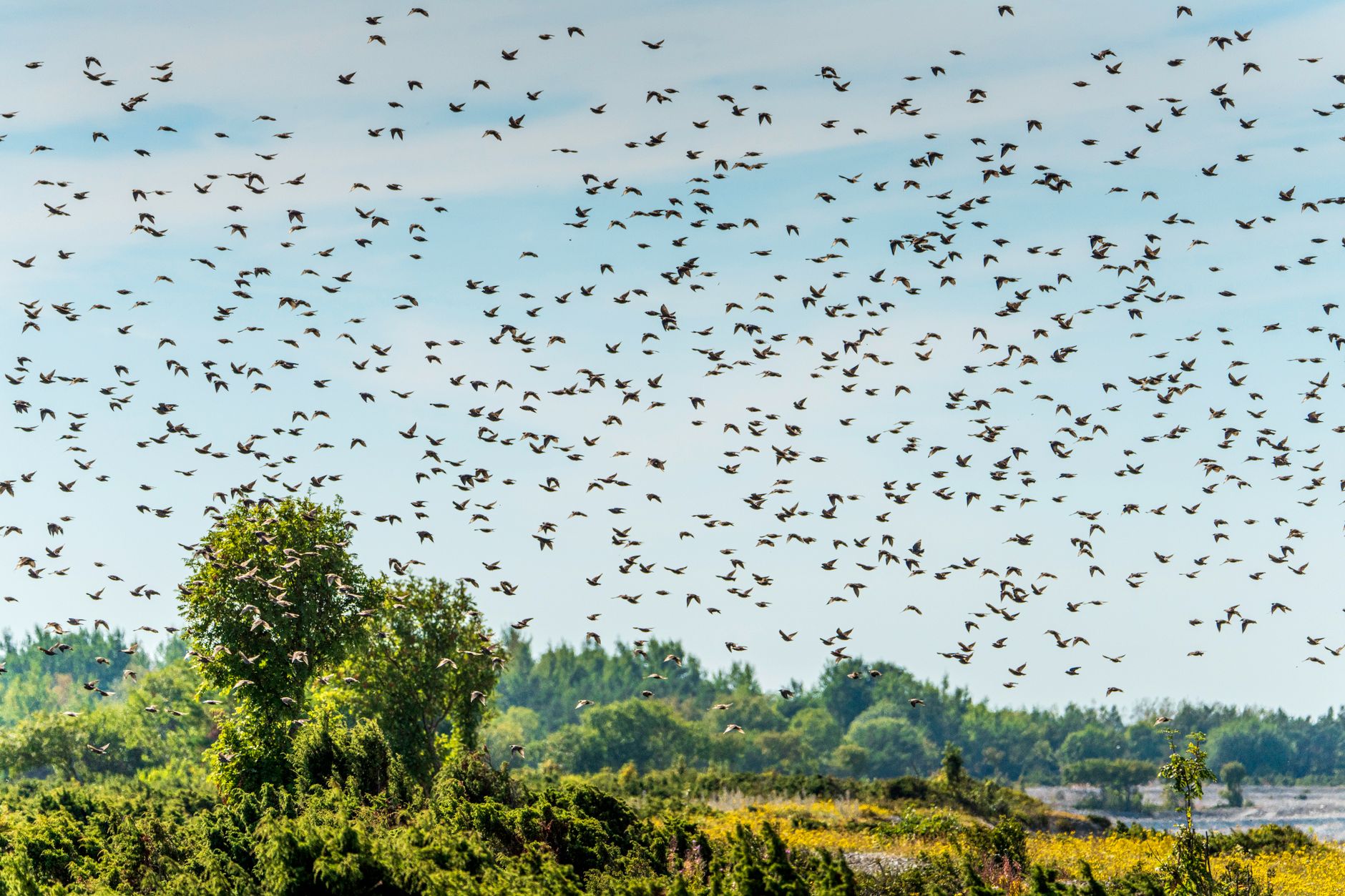
How Many Birds Is Considered A Flock? Unpacking the Ornithological Definition
Determining how many birds is considered a flock? isn’t about a specific number, but rather the behavior of the birds; a flock is defined by coordinated movement and social interaction, regardless of the group’s size.

The Dynamic Definition of a Flock
Defining a flock of birds isn’t as simple as counting heads. It’s about understanding the dynamic social behavior exhibited by birds acting in a coordinated manner. While a pair of birds might be partners, a group of three or more engaging in synchronized flight, foraging, or communal roosting starts to hint at a flock. However, the key is coordinated activity.
Factors Influencing Flock Size

Several factors influence the size of bird flocks, including:
- Species: Some species are inherently more social than others. Starlings, for example, are known for forming massive flocks, while raptors typically prefer solitary existence or small family groups.
- Season: Migration often prompts birds to gather in larger flocks for safety and navigation efficiency. Winter roosting also encourages flocking behavior for warmth and protection.
- Food Availability: Abundant food sources can lead to temporary increases in flock size as birds congregate to take advantage of the bounty.
- Predator Pressure: Larger flocks offer increased vigilance and collective defense against predators.
Benefits of Flocking
Birds flock for a variety of reasons, all aimed at increasing their survival and reproductive success:
- Predator Avoidance: Many eyes are better than two. Flocks provide enhanced vigilance, making it harder for predators to single out an individual. Alarm calls can quickly spread through the flock, alerting everyone to danger. Coordinated evasive maneuvers, like the murmurations of starlings, can confuse and disorient predators.
- Foraging Efficiency: Flocks can efficiently locate and exploit food resources. Information sharing allows birds to learn from each other about the location and quality of food patches.
- Migration Efficiency: Flying in formation reduces drag and conserves energy during long-distance migration. Flocks also benefit from collective navigation skills, leveraging the knowledge of experienced individuals.
- Social Learning: Young birds learn essential survival skills, such as foraging techniques and predator avoidance strategies, by observing and imitating older members of the flock.
- Mate Selection: Larger flocks provide more opportunities for birds to assess potential mates and choose the best partners.
Differentiating a Flock from Other Bird Gatherings
It’s important to distinguish a flock from other groupings of birds. A group of birds simply resting on a wire, without interacting, is not necessarily a flock. Similarly, birds gathered around a bird feeder might be a congregation, but not necessarily a flock unless they exhibit coordinated behaviors.
Consider this table that highlights the differences:
| Feature | Flock | Congregation |
|---|---|---|
| Definition | Coordinated movement and social interaction among birds. | A gathering of birds, often for feeding or resting, without clear coordination. |
| Key Element | Synchronized behavior (e.g., flight, foraging). | Proximity and shared resource use. |
| Example | A murmuration of starlings; a V-formation of migrating geese. | Birds at a bird feeder; gulls resting on a pier. |
| Social Bond | Strong social cohesion and communication. | Limited social interaction beyond shared resource. |
The Murmuration Marvel: A Prime Example
Perhaps the most spectacular example of flocking behavior is the murmuration of starlings. These breathtaking aerial displays involve thousands of birds executing synchronized maneuvers with astonishing precision. The purpose of murmurations is believed to be a combination of predator avoidance, thermal regulation, and social bonding.

Conclusion
How many birds is considered a flock? The answer isn’t a fixed number. The presence of coordinated and social behavior defines a flock, regardless of its size. Understanding the factors that influence flock formation and the benefits of flocking provides valuable insights into the complex social lives of birds.
FAQ: What is the smallest number of birds that could be considered a flock?
Technically, three birds engaging in coordinated activity could be considered a very small flock. The key is that they are moving and behaving together in a way that suggests social cohesion.
FAQ: Are all birds that fly together considered a flock?
No. While flying together is a common characteristic of flocks, it is not sufficient on its own. The birds must exhibit coordinated movement and social interaction to be considered a true flock. Birds migrating together in a loose formation might be considered a flight, but not necessarily a flock if there isn’t coordination.
FAQ: What are some examples of birds that are known for forming large flocks?
Starlings, grackles, snow geese, and red-winged blackbirds are all well-known for forming large flocks, sometimes numbering in the thousands or even millions.
FAQ: Do predators ever form flocks?
While less common than in prey species, some raptors, such as Harris’s Hawks, will occasionally hunt in cooperative groups, which could be considered a type of flock. However, their behavior is more often described as cooperative hunting than traditional flocking.
FAQ: How do birds manage to fly in such perfect synchronization within a flock?
Scientists believe that birds use a combination of visual cues and subtle adjustments to maintain their positions within a flock. Each bird reacts to the movements of its neighbors, creating a cascading effect that allows the flock to move as a single unit.
FAQ: Is there a difference between a flock and a swarm?
While the terms are sometimes used interchangeably, “swarm” is more commonly used to describe groups of insects. Flock is the more appropriate term for birds.
FAQ: What is the evolutionary advantage of flocking behavior?
Flocking provides several evolutionary advantages, including increased predator avoidance, foraging efficiency, and migration success. Birds that flock are more likely to survive and reproduce, passing on their flocking genes to future generations.
FAQ: Can birds from different species form a flock together?
Yes, it is possible for birds from different species to form a mixed-species flock. This often occurs when species share similar foraging habits or face similar predator threats.
FAQ: How does flock size affect individual bird behavior?
In larger flocks, individual birds may experience reduced stress levels due to the increased vigilance of the group. However, they may also face increased competition for resources.
FAQ: What is the collective noun for a group of crows?
A group of crows is often referred to as a murder of crows. However, if they are exhibiting flocking behavior, flock is still applicable.
FAQ: What role does vocalization play in flock behavior?
Vocalizations play a crucial role in coordinating flock movements, communicating danger, and maintaining social cohesion. Different calls can signal different intentions or warn of specific threats.
FAQ: How does how many birds is considered a flock? relate to other animal groupings?
The principles behind defining a bird flock – coordinated movement and social interaction – are similar to those used to define groups of other animals, such as schools of fish or herds of mammals. However, specific behaviors and social structures may vary.