
Tracking wildlife movement requires precision and reliability, especially when you are monitoring remote areas or large properties. Choosing the right equipment can make the difference between capturing a fleeting moment and missing the action entirely. Whether you need real-time updates or a simple, set-and-forget solution, finding the Best Wildlife Camera depends on your specific surveillance goals and the environment you are monitoring.
In this guide, we examine five distinct models that cater to different needs, from cellular units with advanced AI to rugged, non-cellular cameras designed for long-term field use. By understanding the trade-offs between connectivity, power options, and image quality, you can select the tool that best fits your scouting strategy and ensures you never miss a significant wildlife encounter.
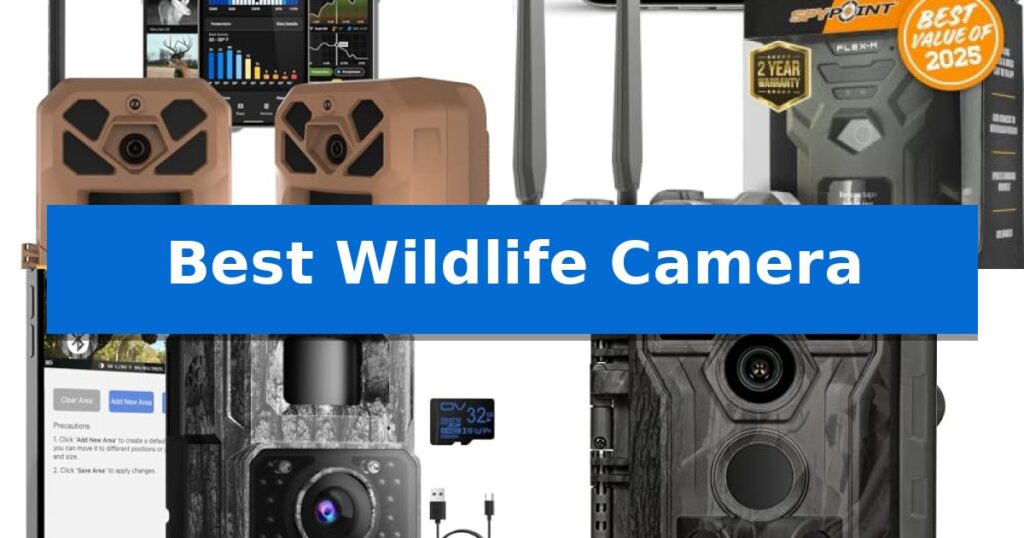
Best Wildlife Camera in 2026: Instant AI Detection and Alerts
1 Moultrie Edge 3 Cellular Trail Camera — Real-time AI Buck Detection
The Moultrie Edge 3 Cellular Trail Camera provides a sophisticated approach to wildlife monitoring by utilizing AI Buck Detection to filter out non-target movement, ensuring you receive high-resolution alerts only when mature bucks are identified. This intelligent system allows for more precise scouting, helping you understand movement patterns without the clutter of false triggers.
Engineered for reliability in remote environments, the Moultrie Edge 3 Cellular Trail Camera features Nationwide 4-Carrier Auto-Connect technology. This system automatically selects the strongest available network signal across four major U.S. providers, eliminating the need for manual SIM card configuration or complex network setups. With its 0.5-second trigger speed and a 100-foot detection range, the camera is built to capture fast-moving subjects with clarity.
Beyond its core imaging capabilities, this model offers advanced remote management through the Moultrie mobile app. Users can leverage Live Aim to preview camera positioning in real-time and utilize built-in GPS to automatically map device locations. The system also supports complete feeder remote control, allowing you to adjust settings and monitor battery levels or feed status from any location.
The hardware is designed for high-quality output, delivering 40MP photos and 1080p HD video. A low-glow infrared flash ensures nighttime visibility without spooking wildlife. To maintain long-term operation, the unit is compatible with rechargeable lithium battery packs and solar panels, reducing the frequency of site visits. Each unit is backed by a 2-year warranty from the date of activation.
PROS
- AI-powered buck detection reduces false alerts.
- Nationwide 4-carrier auto-connect ensures reliable signal coverage.
- Integrated GPS and Live Aim simplify camera placement.
- Remote feeder control capabilities via the mobile app.
CONS
- Active data plan required for cellular functionality.
- Subscription-based service involves ongoing costs.
2 SPYPOINT Flex-M Cellular Trail Camera — Reliable Multi-Network Coverage
Monitoring remote wilderness areas requires equipment that maintains connectivity without manual intervention, which is where the SPYPOINT Flex-M Cellular Trail Camera excels. By utilizing Dual-SIM technology, this camera automatically connects to the strongest available signal across all major carriers, ensuring reliable data transmission in challenging environments where Wi-Fi is unavailable.
The SPYPOINT Flex-M Cellular Trail Camera is engineered for high-performance wildlife observation, capturing 32MP photos and 1080p videos with sound. Users can manage their setup remotely via the free SPYPOINT app, which allows for over-the-air updates and precise location tracking using the integrated GPS locator. This remote management capability ensures that hunting grounds remain undisturbed while you maintain full control over camera settings.
Versatility is a core component of this system, featuring multiple capture modes including Photo, Video, Time-Lapse, and Time-Lapse+. The Time-Lapse+ mode is particularly useful for extensive monitoring, as it triggers the detection sensor alongside interval shots. Furthermore, the inclusion of Constant Capture technology allows the device to seamlessly send and capture images simultaneously, ensuring no action is missed during the transition between files.
Designed for efficiency, the unit features a 0.5-second trigger speed to capture fast-moving subjects effectively. While the camera is built for durability, users can extend its operational autonomy by pairing it with compatible solar panels. This combination of multi-network coverage and advanced capture modes makes it a robust solution for those requiring consistent, high-quality data from remote locations.
PROS
- Dual-SIM technology provides automatic connection to the strongest available cellular network.
- Remote management via the SPYPOINT app allows for over-the-air updates and GPS tracking.
- Constant Capture technology enables simultaneous image capture and transmission.
- Versatile capture modes including Time-Lapse+ for comprehensive area monitoring.
CONS
- MicroSD card not included, requiring a separate purchase for storage.
- Solar panels sold separately, which are necessary for extended field autonomy.
3 MAXDONE Solar Trail Camera — Non-Stop Solar Power
Maintaining consistent surveillance in remote outdoor environments requires a reliable power source, and the MAXDONE Solar Trail Camera addresses this with an upgraded split solar panel design. This configuration allows for flexible placement, enabling the panel to be manually adjusted to face the sun directly for maximum charging efficiency, regardless of the terrain or seasonal changes.
The camera is built for high-performance monitoring, featuring 4K and 64MP ultra-clear imaging to capture detailed footage with minimal blur. Its infrared night vision technology provides visibility up to 65 feet in low-light conditions, ensuring clear behavioral details are recorded without disturbing wildlife. With a rapid 0.1-second trigger speed, the device is engineered to capture fast-moving subjects accurately.
Usability is enhanced through the TrailCamGO app, which pairs via WiFi and Bluetooth to allow for direct file transfers to your phone without the need to remove the SD card. The camera creates its own short-range hotspot for these functions, meaning it operates independently of home networks. It also includes a 6000mAh rechargeable power system that supports solar, Type-C, and traditional charging for continuous, long-term operation.
Designed for durability, the unit carries an IP66 waterproof rating, making it suitable for reliable performance in rainy or humid conditions. The system supports multiple recording modes, including time-lapse, scheduled shooting, and 5-shot burst, providing versatility for various surveillance needs. By utilizing customizable detection zones, the camera helps reduce false triggers, ensuring that storage is used efficiently for relevant activity.
PROS
- Upgraded split solar panel for optimized charging efficiency.
- 6000mAh high-capacity battery for long-term, non-stop operation.
- 4K and 64MP resolution for high-quality image and video capture.
- 0.1-second trigger speed for capturing fast-moving wildlife.
- IP66 waterproof rating for reliable outdoor use.
CONS
- No compatibility with home WiFi or cellular networks.
- Limited WiFi range of 33–50 feet for file downloads.
4 GardePro E5S Trail Camera — Ultra-Fast Trigger Response
Capturing elusive wildlife requires precision, and the GardePro E5S Non-Cellular Trail Camera delivers with a lightning-fast 0.1s trigger speed. By utilizing three PIR sensors, this device ensures that fast-moving subjects are recorded instantly, making it a highly effective tool for monitoring activity in remote hunting or observation areas.
The GardePro E5S Non-Cellular Trail Camera is engineered for high-fidelity documentation, featuring an advanced optical lens capable of producing 64MP photos and 1296P HD videos with sound. This clarity allows for detailed observation of wildlife behavior, while the 100ft no-glow night vision ensures that the camera remains discreet, preventing disturbances during nocturnal monitoring sessions.
Designed for long-term outdoor deployment, the unit features a rugged IP66 waterproof rating to withstand harsh environmental conditions. Its non-cellular and non-WiFi operation prioritizes power efficiency, extending battery life significantly. Users can rely on 8 AA batteries for standard operation or integrate the GardePro SP350 Solar Panel for continuous, maintenance-free power in deep wilderness settings.
Versatility is central to the design, offering Motion Detection, Time-Lapse, and Hybrid recording modes to suit specific research or scouting goals. The device supports SD cards up to 512GB, providing ample space for high-resolution media. With in-camera playback and loop recording capabilities, managing captured data is straightforward, ensuring that storage is always optimized for the next event.
PROS
- 0.1s trigger speed with triple PIR sensors for rapid motion capture.
- High-resolution 64MP photos and 1296P HD video output.
- IP66 weather-resistant housing for durable outdoor use.
- Supports up to 512GB SD cards for extensive storage capacity.
- Compatible with solar panel power for extended, remote operation.
CONS
- Batteries and SD card are not included with the unit.
- Non-cellular design requires manual SD card retrieval for data access.
5 WOSPORTS G600 Trail Camera — Wide-Angle Night Vision
Capturing wildlife behavior in complete darkness is made possible by the WOSPORTS G600 Trail Camera, which utilizes 32pcs 940 IR LEDs to provide no-glow night vision. This design choice ensures that the camera remains invisible to animals, preventing them from being startled while the device records natural activity.
The WOSPORTS G600 Trail Camera is engineered for high-resolution documentation, offering 64MP photo resolution and 4K HD video recording. Its 0.2S trigger speed ensures that fast-moving subjects are captured instantly, while the 120° wide-angle detection provides a broad field of view suitable for monitoring deer trails, farm perimeters, or backyard security.
Usability is enhanced by the integrated 2-inch color LCD screen, allowing for direct previewing of captured media without the need to remove the SD card. The device supports storage up to 256GB and features an intuitive menu system protected by password security, ensuring that settings remain undisturbed during extended outdoor deployments.
For power management, the camera offers flexible options, including 8xAA batteries, an optional rechargeable lithium battery, or a compatible solar panel. This versatility, combined with its waterproof construction, makes it a reliable tool for long-term wildlife observation and property surveillance in various environmental conditions.
PROS
- No-glow infrared LEDs prevent startling wildlife during night monitoring.
- High-definition 4K video and 64MP photo capture capabilities.
- Rapid 0.2S trigger speed for immediate motion activation.
- Flexible power options including solar panel compatibility.
CONS
- Batteries and SD card are not included with the device.
- Rechargeable battery and solar panel must be purchased separately.
Best Wildlife Camera Buying Guide
Connectivity and Data Transmission
The most significant decision when choosing a camera is whether you need cellular connectivity or a non-cellular model. Cellular cameras, like those from Moultrie or SPYPOINT, transmit images directly to your mobile device, allowing for real-time monitoring without needing to visit the site.
Conversely, non-cellular models require you to physically retrieve an SD card to view your footage. These are often more cost-effective and avoid the need for a monthly data subscription, making them ideal for stable, accessible locations where immediate alerts are not a priority.
Trigger Speed and Detection Range
A camera's trigger speed determines how quickly it begins recording once motion is detected. A fast trigger, such as 0.1 or 0.5 seconds, is essential for capturing fast-moving animals without blur. Look for models with multiple PIR sensors to widen the detection field.
The detection range also plays a critical role, as it dictates how far away an animal can be before the camera activates. A range of 90 to 100 feet is generally sufficient for most trail and backyard setups, ensuring you capture activity across a wide area.
Power Management and Solar Integration
Maintaining power in remote locations is a common challenge. Many modern cameras now support rechargeable lithium packs or solar panel compatibility, which can significantly extend the time between battery changes.
For long-term deployment, a solar-powered trail camera is an excellent investment. These units often feature internal batteries that are kept charged by the sun, reducing the need for frequent trips into the woods and minimizing human disturbance in the area.
Image and Video Quality
High-resolution sensors are standard in today's market, with many models offering 40MP to 64MP photo resolution and 1080p or 4K video recording. Higher megapixel counts provide more detail, which is helpful when you need to identify specific animal features or track movement patterns.
Consider the night vision capabilities as well. Cameras using no-glow infrared LEDs are preferred for wildlife observation because they remain invisible to animals, ensuring that your presence—and your camera—do not spook the subjects you are trying to study.
Durability and Weather Resistance
Since these devices are designed to stay outdoors year-round, IP66-rated weather resistance is a vital feature. This rating ensures the camera is protected against dust and heavy rain, allowing it to function reliably in harsh, humid, or stormy conditions.
Look for rugged, camouflaged housings that blend into the natural environment. A secure mounting system, such as a 1/4"-20 thread, allows you to attach the camera firmly to trees or posts, preventing it from shifting due to wind or animal activity.
Frequently Asked Questions
Do I need a subscription for cellular trail cameras?
Yes, cellular trail cameras require an active data plan to transmit photos and videos to your phone. These plans are typically managed through the manufacturer's app and offer various billing cycles.
Can I use a non-cellular camera for home security?
Yes, many non-cellular cameras are suitable for home security. They record motion-activated footage to an SD card, which you can review later, though they do not provide instant push notifications.
How do I keep my camera powered in the woods?
Using a compatible solar panel or high-capacity rechargeable battery packs is the most effective way to keep your camera powered for months without needing to visit the site.
What is the difference between low-glow and no-glow infrared?
Low-glow infrared may emit a faint red light that some animals can see, while no-glow infrared is completely invisible to both humans and wildlife, making it better for stealth.
Are these cameras difficult to set up?
Most modern trail cameras are designed for easy setup. Cellular models often use mobile apps for activation, while non-cellular models feature intuitive on-device menus for configuration.
Conclusion: Our Top Pick
When selecting the right equipment for your outdoor monitoring, the Moultrie Edge 3 Cellular Trail Camera stands out as a top choice due to its advanced AI buck detection and reliable multi-carrier connectivity. By automatically connecting to the strongest available network, it ensures that you receive high-resolution images and video updates directly to your mobile app, even in remote locations.
While cellular models like the Moultrie Edge 3 offer the convenience of remote management, it is important to remember that they require a data plan. If you prefer a setup without recurring costs, non-cellular options remain highly effective for capturing high-quality footage. Regardless of your choice, prioritizing features like fast trigger speeds and weather-resistant designs will ensure your camera performs consistently throughout the season.