
When the power grid fails or you find yourself far from civilization, having a reliable energy source is essential for maintaining comfort and safety. Finding the Best Outdoor Generator requires balancing your specific power demands with the portability and fuel type that best fits your lifestyle, whether you need heavy-duty home backup or lightweight energy for camping.
We have evaluated the top options on the market to help you navigate the complex world of portable power. From high-capacity fuel-driven engines to quiet, clean solar-powered stations, our guide breaks down the key features and trade-offs of each model to ensure you make an informed decision for your next emergency or outdoor excursion.
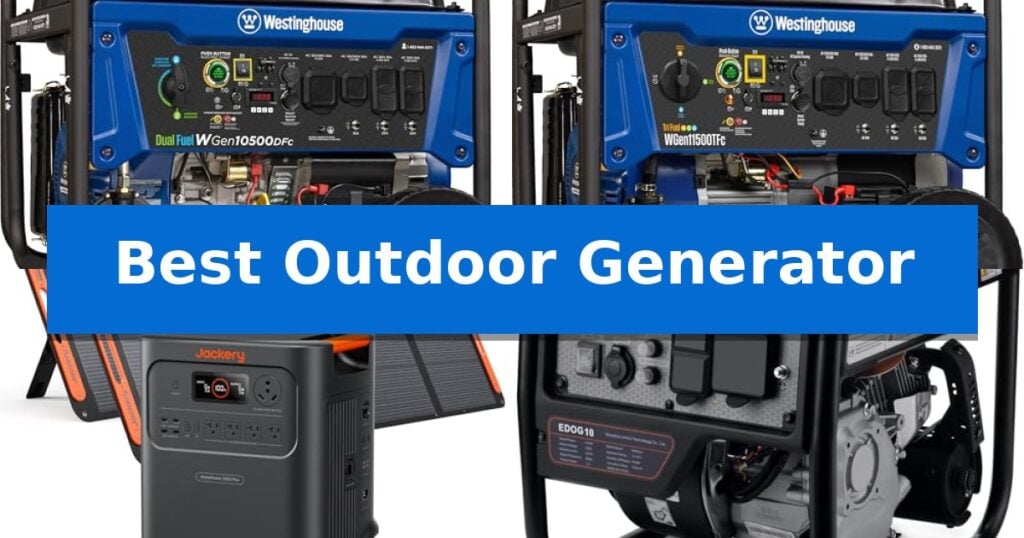
Best Outdoor Generator in 2026: Power Your Home and Campsite
1 Westinghouse WGen10500DFc Portable Generator — Best for Heavy-Duty Home Backup
Maintaining power during an outage requires a reliable solution, and the Westinghouse WGen10500DFc Portable Generator introduces a unique, first-of-its-kind technology by pairing with the Westinghouse WATS200 Automatic Transfer Switch. This integration allows for automatic home backup capabilities in a portable format, bridging the gap between standby convenience and the flexibility of a mobile unit.
Engineered for durability, this generator features a powerful 500cc engine equipped with a pressure lubrication system. This design actively delivers oil to critical components to minimize friction and wear, while a reusable oil screen captures contaminants to ensure cleaner oil circulation and long-term performance reliability.
The unit offers significant fuel flexibility, allowing users to operate on either gasoline or propane. When running on gasoline, it delivers 10,500 running watts and 13,500 peak watts. For extended use, the 9.5-gallon gasoline tank provides up to 19 hours of runtime at a 25% load, with a built-in fuel gauge for quick monitoring.
Usability is prioritized through multiple starting methods, including push-button electric start and a convenient remote key fob, with a backup recoil starter included for added versatility. Safety is integrated into the core design, featuring automatic low-oil shutdown and a CO sensor that monitors for elevated carbon monoxide levels to protect the operator.
Designed for seamless home integration, the generator includes 50A and 30A outlets compatible with interlock kits or manual transfer switches. It is further supported by a 3-year limited residential warranty and lifetime technical support, providing peace of mind for heavy-duty backup requirements.
PROS
- Automatic transfer switch compatibility for seamless home backup.
- Dual fuel capability allowing for gasoline or propane operation.
- High power output with 13,500 peak watts.
- Pressure lubrication system for enhanced engine longevity.
CONS
- Automatic transfer switch sold separately from the generator unit.
- Heavy construction weighing 230 pounds.
2 Westinghouse WGen11500TFc Tri-Fuel Generator — Maximum Fuel Versatility
Managing home power security requires a reliable source that adapts to your specific fuel availability, and the Westinghouse WGen11500TFc Tri-Fuel Generator addresses this with its versatile gas, propane, and natural gas compatibility. This model is engineered to provide a robust 11,500 running watts and 14,500 peak watts when powered by gasoline, ensuring you have the necessary capacity to support essential home appliances during outages.
The generator features a powerful 550cc engine equipped with a pressure lubrication system designed to reduce friction and extend engine life. Maintenance is simplified through a reusable oil screen that effectively captures contaminants. For those concerned about sensitive electronics, the unit delivers less than 5% THD, providing clean power suitable for phones, computers, and televisions.
Usability is enhanced by the push-button and remote start functionality, allowing for convenient activation. When paired with the Westinghouse WATS200 Automatic Transfer Switch, this unit offers a seamless transition to backup power, effectively bridging the gap between standby convenience and portable utility. Its design includes 50A and 30A outlets, making it well-suited for integration with manual transfer switches or interlock kits.
Safety remains a priority with the inclusion of an automatic low-oil shutdown and a dedicated CO sensor that monitors for elevated carbon monoxide levels. The unit is built for durability, featuring copper windings that help the generator run cooler over extended periods. With a 9.5-gallon gas tank, it can provide up to 19 hours of runtime at 25% load, offering a balanced solution for long-term power needs.
PROS
- Tri-fuel flexibility allows for operation on gasoline, propane, or natural gas.
- Automatic transfer switch compatibility enables seamless home backup integration.
- Low THD (under 5%) ensures safe power delivery for sensitive electronics.
- Pressure lubrication system and reusable oil screen support long-term engine health.
CONS
- Transfer switch sold separately, requiring an additional purchase for automatic backup functionality.
3 Jackery HomePower 3600 Plus Solar Generator — Clean Power for Large Households
Maintaining power during an outage requires a solution that balances high capacity with ease of use, and the Jackery HomePower 3600 Plus Solar Generator is engineered specifically for this purpose. Featuring a robust 3584Wh capacity that is expandable up to 21kWh per unit, this system provides the necessary energy to keep essential home appliances running for over two weeks for a three-person household.
The Jackery HomePower 3600 Plus delivers a powerful 3600W AC output, which can be pushed to 7200W in parallel to support demanding appliances like pumps, heaters, and dryers. Its dual voltage capability (120V & 240V in parallel) ensures compatibility with a wide range of household equipment, making it a versatile choice for emergency backups or off-grid living.
Safety and longevity are central to the design, utilizing high-temp resistant ceramic membrane battery cells that are tested at 302 °F to prevent thermal runaway. These LFP battery cells are rated for 6,000 cycles and a 10-year lifespan, ensuring reliable performance even in extreme conditions as low as -4 °F. The unit also features automotive-grade CTB technology, making it 34% smaller and 29.3% lighter than comparable models.
Usability is enhanced by a plug-and-play design that works with an MTS for seamless home integration without complex installations. For recharging, the system offers four methods, including a hybrid AC+DC option that achieves a 0–100% charge in just 2 hours. The unit is designed for mobility with a luggage-style build, featuring wheels and a telescopic handle for easy transport between locations.
While the system offers significant power, users should note that the Jackery HomePower 3600 Plus and its solar panels are shipped separately and may arrive in different packages. Additionally, the high-capacity nature of the unit results in a weight of 77.16 pounds, though the integrated wheels and handle are included to mitigate this.
PROS
- High-capacity LFP battery expandable up to 21kWh per unit.
- 3600W AC output with parallel capability up to 7200W.
- Fast charging via hybrid AC+DC in just 2 hours.
- Durable design with a 10-year lifespan and 6,000 charge cycles.
- Portable luggage-style design with wheels and telescopic handle.
CONS
- Separate shipping of the power station and solar panels.
- Substantial unit weight of 77.16 pounds.
4 Oxseryn EDOG10 Inverter Generator — Lightweight Pick for RV Camping
Reliable power during an outage or while off-grid requires a balance of capacity and portability, which is exactly where the Oxseryn EDOG10 Inverter Generator excels. Weighing only 56lbs, this unit provides a manageable solution for those who need to transport their power source between campsites or store it efficiently for emergency home backup.
The Oxseryn EDOG10 Inverter Generator delivers 4400 peak watts and 3400 running watts, ensuring you have enough energy for essential appliances or RV electronics. It features a versatile array of multi-output options, including two 120V AC ports, one 12V DC port, and a dedicated RV port, allowing for simultaneous use of multiple devices.
Efficiency is central to its design, highlighted by an ECO mode that helps optimize fuel consumption. When operating at 25% load, the generator can run for up to 14 hours on its 2-gallon fuel tank. Users can monitor fuel levels easily thanks to the integrated fuel gauge, which provides a quick visual check to ensure you remain prepared.
Designed for quieter operation, the unit maintains noise levels under 72 dBA from 23 feet away, making it a suitable choice for residential areas or campgrounds. While the generator is factory-tested to ensure functionality, it is worth noting that a slight residual smell of gas may be present upon arrival, which is a standard result of the testing process.
With its compact dimensions of 19.1 inches in height and 15.6 inches in width, this open-frame generator fits easily into storage spaces. It is backed by a 1-year manufacturer warranty, providing coverage for the unit's core components.
PROS
- Lightweight 56lb design for easy portability.
- Versatile multi-output panel including a dedicated RV port.
- Extended 14-hour runtime at 25% load with ECO mode.
- Integrated fuel gauge for convenient level monitoring.
CONS
- Open frame design may be louder than fully enclosed inverter models.
- Residual gas smell possible due to factory testing.
5 Jackery Explorer 300 Portable Power Station — Ultra-Portable Off-Grid Energy
Maintaining power during off-grid excursions is simplified by the Jackery Explorer 300 Portable Power Station, which weighs only 7.5 lbs while providing a substantial 292Wh capacity. This unit is specifically engineered for portability, featuring a sleek, integrated handle that allows users to transport reliable energy on long hikes or pack it efficiently alongside other camping gear without adding unnecessary bulk.
The device offers versatile connectivity for up to 6 devices simultaneously, including 2 AC outlets, a 100W USB-C PD port, 2 USB-A ports, and a 120W car port. With a 300W rated output and a 600W peak surge, it is capable of powering essential electronics like laptops, drones, and cameras, or serving as a dependable power source for medical equipment such as CPAP machines during overnight trips.
Durability is a core component of this model, which utilizes premium LiFePO4 chemistry. This advanced battery technology supports over 4,000 charge cycles before reaching 70% capacity, translating to more than 11 years of reliable service life. This long-term sustainability makes it a practical investment for those who frequently engage in outdoor activities or require a consistent backup power solution for blackouts.
For those operating entirely off-grid, the unit supports Fast Solar Charging when paired with compatible solar panels. Users can reach 80% capacity in approximately 2.8 hours using a 100W solar panel or 7.5 hours with a 40W panel. This flexibility ensures that the generator remains a functional part of any hunting or camping kit, keeping gear charged even in remote locations where traditional power outlets are unavailable.
PROS
- Ultra-lightweight design at only 7.5 lbs for superior portability.
- Premium LiFePO4 battery chemistry offering over 4,000 charge cycles.
- Versatile output options including AC, USB-C PD, and car port connectivity.
- Fast solar charging capability reaching 80% in under 3 hours.
CONS
- Solar panels are not included and must be purchased separately.
- Physical address required for delivery; cannot be shipped to PO Boxes.
Best Outdoor Generator Buying Guide
Understanding Power Capacity
The most critical factor when selecting a generator is determining your total wattage requirements. You must calculate the combined running watts of all the appliances you intend to power simultaneously, such as refrigerators, heaters, or medical devices. Always account for the starting surge wattage, which is the temporary power spike required to kick-start motors in appliances like air conditioners or pumps.
For heavy-duty home backup, look for models offering high running wattage and multiple high-amperage outlets. If your needs are limited to charging laptops, cameras, or small fans, a lower-capacity portable power station will provide sufficient energy without the weight and noise associated with traditional fuel-burning engines.
Fuel Versatility and Runtime
Generators typically rely on gasoline, propane, natural gas, or battery storage. Dual-fuel or tri-fuel generators offer the most flexibility, allowing you to switch between fuel sources depending on availability and cost. Propane is often preferred for long-term storage because it does not degrade like gasoline, making it an excellent choice for emergency preparedness.
For those prioritizing sustainability and silent operation, solar generators are the way to go. These units use high-capacity LiFePO4 batteries that can be recharged via solar panels or AC wall outlets. While they lack the continuous runtime of fuel-based models, they provide clean, emission-free power that is ideal for indoor use or quiet campsites.
Portability and Storage
If you plan to move your generator frequently between a garage, RV, or campsite, weight and design are paramount. Look for units featuring integrated wheels, telescopic handles, and ergonomic grips. Even heavy-duty generators can be manageable if they are designed with a balanced, luggage-style frame.
Consider the physical footprint of the unit as well. Compact designs are easier to store in tight spaces like closets or RV storage bays. Always ensure your chosen location offers adequate ventilation, as all fuel-burning generators must be operated outdoors to avoid the buildup of carbon monoxide.
Safety Features and Maintenance
Modern generators come equipped with essential safety features that protect both the user and the equipment. An automatic low-oil shutdown is vital for preventing engine damage, while a CO sensor provides a crucial layer of protection by automatically shutting down the unit if dangerous levels of carbon monoxide are detected.
Maintenance is key to ensuring your generator starts when you need it most. Models with pressure lubrication systems and reusable oil screens help reduce internal engine wear. Regularly checking fuel levels and performing routine maintenance will significantly extend the lifespan of your investment.
Inverter Technology vs. Standard Generators
If you are powering sensitive electronics like smartphones, tablets, or smart TVs, you should prioritize an inverter generator. These units produce a clean, stable sine wave with less than 5% THD (Total Harmonic Distortion), preventing potential damage to delicate circuitry that can occur with the fluctuating power of standard generators.
Inverter models are also generally quieter and more fuel-efficient, often featuring an ECO mode that adjusts engine speed based on the power load. This makes them the preferred choice for camping and residential areas where noise pollution is a concern.
Frequently Asked Questions
What is the difference between running watts and peak watts?
Running watts represent the continuous power a generator can provide, while peak watts (or surge watts) refer to the maximum power the unit can deliver for a short duration to start appliances with electric motors.
Can I use a generator inside my house?
No. You must never operate a fuel-burning generator indoors, in a garage, or near windows and vents, as they produce lethal carbon monoxide gas.
How long will a solar generator last?
The lifespan of a solar generator depends on the battery chemistry. Units using LiFePO4 batteries can often provide thousands of charge cycles, lasting over a decade with proper care.
What is a transfer switch?
A transfer switch allows you to safely connect your generator to your home's electrical panel, enabling you to power hardwired circuits like lights and appliances during an outage.
Do I need to perform maintenance on my generator?
Yes. Regular maintenance, such as changing the oil, checking air filters, and running the unit periodically, is essential to keep the engine in good working condition.
Conclusion: Our Top Pick
When choosing the right power solution, the Westinghouse WGen10500DFc Portable Generator stands out as our top recommendation for those needing a robust, versatile, and reliable home backup system. Its dual-fuel capability provides excellent flexibility during emergencies, while the high power output ensures you can run essential household appliances without compromise.
While other models offer specific advantages like extreme portability or silent solar operation, this unit strikes the best balance of power, durability, and ease of use for most homeowners. Its integration with automatic transfer switches and built-in safety sensors makes it a dependable choice for long-term power security.