
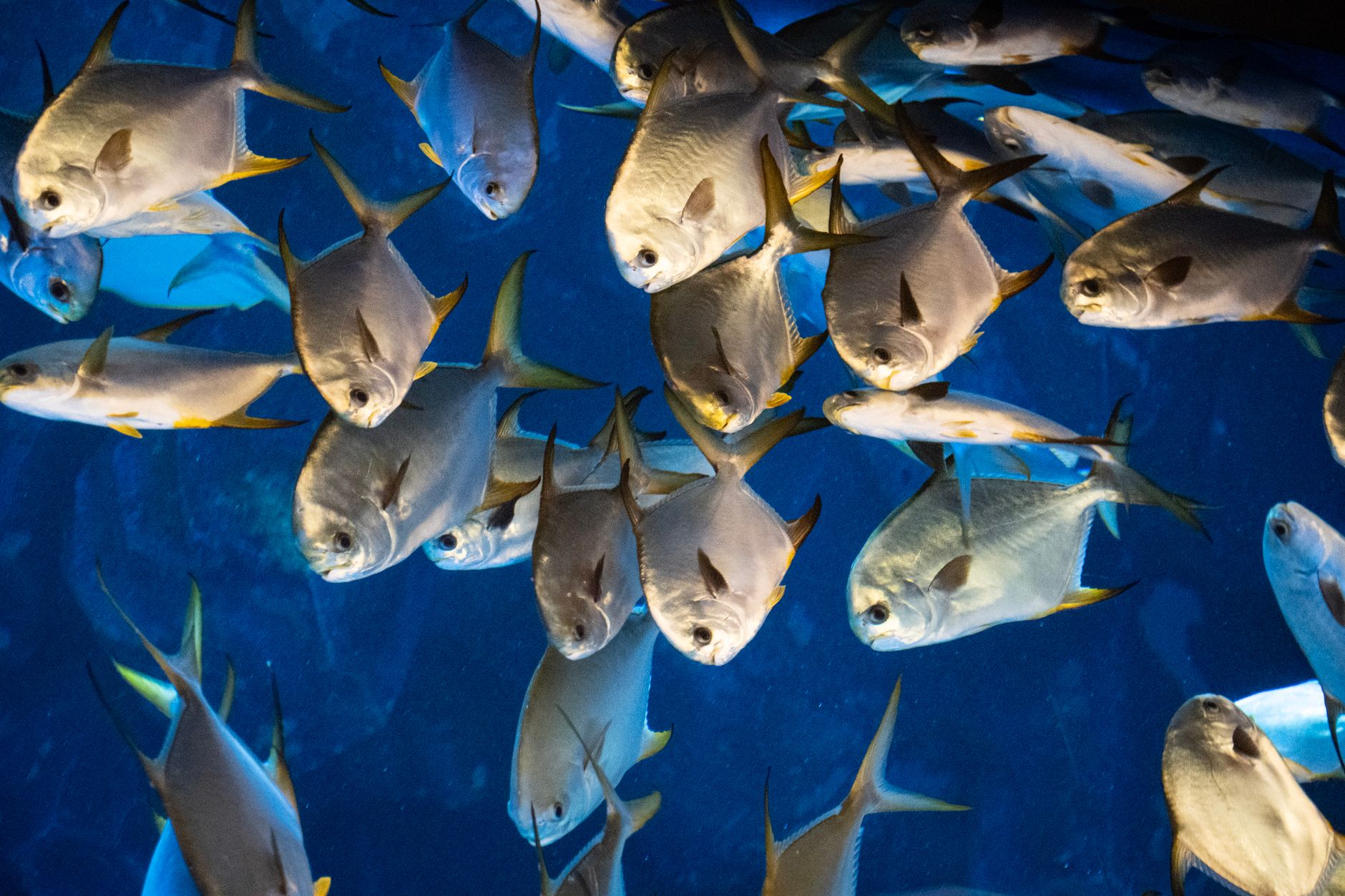
How Do Schools of Fish Communicate? Unveiling the Secrets of Underwater Coordination
Schools of fish communicate through a sophisticated blend of visual cues, hydrodynamic signals, and possibly even subtle electrical fields, enabling them to maintain synchronized movements and collective awareness. This complex interplay allows for efficient predator avoidance, foraging, and navigation, crucial for their survival.

Introduction: The Enigmatic World of Fish Schools
The mesmerizing sight of a school of fish moving in perfect unison is a testament to the power of collective behavior. But how do schools of fish communicate to achieve such remarkable coordination? For centuries, scientists have been captivated by this question, and while many pieces of the puzzle have been identified, the full picture remains a fascinating area of ongoing research. This article delves into the intricate mechanisms that enable these underwater collectives to function as a single, highly responsive entity. Understanding these communication strategies is not only crucial for appreciating the complexity of marine ecosystems but also for potentially inspiring innovations in fields like robotics and artificial intelligence.
Visual Communication: A Symphony of Sight

One of the primary ways how schools of fish communicate is through visual cues. Fish possess highly developed visual systems, enabling them to detect subtle changes in the movements and positions of their neighbors.
- Lateral Line System: While technically not visual, this sensory system detects changes in water pressure caused by the movements of nearby fish. Think of it as feeling the vibrations created by your neighbors.
- Body Posture and Orientation: Fish constantly monitor the posture and orientation of those around them, adjusting their own movements to maintain alignment and cohesion within the school.
- Color and Patterns: Some species use color changes or patterns on their bodies to signal alarm, attract mates, or communicate other important information.
- Light Modulation: The way fish reflect light and how that is perceived by the other fish is also an important part of the visual communication.
Hydrodynamic Communication: Riding the Waves
Beyond visual cues, fish also communicate through hydrodynamic signals, essentially sensing the water currents created by the movements of other fish. This form of communication is particularly important in low-visibility conditions or at night.
- Detection of Vortices: Fish can detect the tiny swirling currents (vortices) generated by the tail movements of their neighbors, allowing them to anticipate changes in direction and maintain synchrony.
- Pressure Gradients: Fish can also sense subtle pressure gradients in the water, providing information about the position and movement of other fish.
- Spatial Arrangement: They can arrange themselves into energy saving positions behind other fish, which facilitates efficient group swimming.
Electrical Communication: The Silent Language
Although less common than visual and hydrodynamic communication, some fish species utilize electrical signals to communicate within schools.
- Weakly Electric Fish: These fish possess specialized organs that generate weak electrical fields, which they use to detect objects and communicate with each other.
- Electric Organ Discharges (EODs): Fish can modulate the frequency and amplitude of their EODs to convey information about their identity, sex, and social status.
The Benefits of Schooling: Strength in Numbers
The ability to communicate effectively within a school provides numerous benefits to individual fish, contributing to their survival and reproductive success.
- Predator Avoidance: Schooling can confuse predators, making it difficult for them to single out and capture individual fish. The “many eyes” effect also increases the chances of detecting predators early on.
- Enhanced Foraging: Schools can collectively search for food more efficiently than individual fish, increasing their chances of finding scarce resources.
- Improved Navigation: Fish schools can navigate long distances with remarkable accuracy, potentially by using collective knowledge and experience.
- Increased Mating Opportunities: Schooling can bring potential mates together, increasing the chances of successful reproduction.
Coordination Challenges: Maintaining Order in Chaos
Maintaining coordination within a school of fish presents significant challenges, requiring precise communication and rapid response times.
- Information Overload: Each fish must process a vast amount of information from its neighbors, filtering out irrelevant signals and focusing on critical cues.
- Time Delays: Communication signals travel at a finite speed, meaning that there is always a slight delay between when a fish initiates a movement and when its neighbors respond.
- Environmental Noise: Turbulence, currents, and other environmental factors can interfere with communication signals, making it difficult for fish to accurately perceive their surroundings.
- Maintaining Cohesion: Individuals need to balance their individual needs with the groups in order to maintain order.

Frequently Asked Questions (FAQs)
How quickly can fish schools react to a threat?
Fish schools can react with astonishing speed, often changing direction or dispersing in a matter of milliseconds. This rapid response is due to the highly efficient communication mechanisms described above, allowing information to propagate quickly throughout the school.
Do all fish species school?
No, not all fish species school. Schooling is more common among smaller fish that are vulnerable to predation. Larger, predatory fish often live solitary lives or in small groups.
Is there a leader in a fish school?
While it may appear that way, most research suggests that there is no designated leader in a fish school. Instead, the school’s movements are guided by a collective decision-making process, with individual fish influencing the group based on their position and actions.
How does schooling benefit young fish?
Schooling provides young fish with protection from predators, increased foraging opportunities, and a chance to learn from more experienced individuals. It greatly enhances their survival rates during the vulnerable early stages of their lives.
Can fish schools break apart and reform?
Yes, fish schools can break apart and reform depending on the situation. They may disperse to forage for food or avoid obstacles, and then re-aggregate later to maintain the benefits of schooling.
What is the role of the lateral line in schooling behavior?
The lateral line is crucial for detecting changes in water pressure caused by the movements of nearby fish, allowing them to maintain synchrony and coordination, especially in low-visibility conditions.
Do different species of fish communicate differently in schools?
Yes, different species of fish may use different communication strategies depending on their morphology, habitat, and social behavior. Some species may rely more heavily on visual cues, while others may rely more on hydrodynamic or electrical signals.
How do schools of fish communicate in murky water?
In murky water, visual communication is limited, so fish rely more on hydrodynamic and electrical signals to maintain coordination. The lateral line system becomes especially important in these conditions.
Can schooling behavior be affected by pollution?
Yes, pollution can disrupt schooling behavior by interfering with the fish’s sensory systems or by altering the chemical composition of the water, making it difficult for them to communicate effectively.
How do fish schools coordinate changes in direction?
Changes in direction are often initiated by a few individuals at the front of the school, and the movement quickly propagates backwards through the group. This is facilitated by the rapid exchange of visual and hydrodynamic cues.
Are there any mathematical models that describe how fish schools move?
Yes, there are several mathematical models that attempt to describe the dynamics of fish schools, often based on principles of self-organization and emergent behavior. These models can help us understand how individual interactions give rise to the collective behavior of the school.
How does human activity impact fish schooling behavior?
Human activities, such as fishing, boat traffic, and underwater noise pollution, can disrupt fish schooling behavior by causing stress, altering their movement patterns, and interfering with their communication signals.